• Skip to main content

Selah

Creating moments for an INTENTIONAL PAUSE

  • ABOUT US
  • BLOG
    • Judaism
    • Oberammergau
    • Tour Prep
    • Tour Reflection
    • Tour Retrospective
  • TRAVEL & TOURS
  • TRAVEL ESSENTIALS
    • INSURANCE
    • E-SIMS
  • CONTACT US
  • SEED
  • Judaism

    When Is the Best Time to Visit the Holy Land?

    July 15, 2026 by Lisa Tarzia

    For Christians, visiting the Holy Land is far more than a holiday—it’s an opportunity to walk where Jesus walked, deepen your understanding of Scripture, and experience the places where God’s redemptive story unfolded.

    While Israel can be visited year-round, the best times for a Christian touring are during spring (March to May) and autumn (September to November). These seasons offer comfortable temperatures, ideal conditions for sightseeing, and plenty of opportunities to enjoy the biblical landscapes on foot.

    Spring (March–May)

    Spring is one of the most beautiful seasons in Israel. The hills of Galilee are green, wildflow

    ers are in bloom, and the weather is perfect for exploring sites such as the Sea of Galilee, Caesarea Philippi, Mount Arbel and Jerusalem.

    For Christian pilgrims, it is a particularly meaningful time to reflect on the life, death and resurrection of Jesus. However, if travelling around Easter, be prepared for larger crowds and higher demand for accommodation.

    Autumn (September–November)

    Autumn is the season we most often recommend for Christian tours. The intense summer heat has eased, the skies are generally clear, and temperatures are ideal for exploring archaeological sites, walking the streets of Jerusalem, floating in the Dead Sea, and spending time around the Sea of Galilee.

    October is especially popular with Australian travellers, offering warm days, pleasant evenings, and excellent conditions for outdoor worship, teaching and reflection.

    Seasons to Consider Carefully

    Summer (June–August) can be extremely hot, particularly in Jerusalem, Jericho, Masada and the Dead Sea region, where temperatures regularly exceed 35–40°C. While travel is certainly possible, sightseeing often needs to begin early in the morning to avoid the midday heat. Try and stay at hotels that have a swimming pool.

    Winter (December–February) brings cooler temperatures and occasional rain, particularly in Jerusalem and Galilee. Although there are fewer crowds and the countryside becomes beautifully green, shorter daylight hours can limit sightseeing.

    Planning Around Jewish Holidays

    One of the most important considerations when planning a Christian tour is the Jewish holiday calendar. During major Jewish festivals, many museums, archaeological parks, restaurants and businesses may close or operate on reduced hours. Public transport is also significantly affected.

    The main holidays to be aware of include:

    • Passover (Pesach) – Many attractions and businesses close or operate with reduced services.
    • Rosh Hashanah (Jewish New Year) – Widespread closures and limited transport.
    • Yom Kippur – The holiest day of the Jewish year. Almost all businesses close, roads are largely empty, and public transport ceases nationwide.
    • Sukkot (Feast of Tabernacles) – A joyful festival that attracts many local families to national parks and popular sites, making some attractions busier than usual.

    For this reason, experienced Selah carefully schedules departures to maximise access to biblical sites while avoiding unnecessary disruptions.

    Selah’s Recommendation

    If you’re planning your first journey to the Holy Land, October is our favourite time to visit. The weather is consistently pleasant, the crowds are generally more manageable than at Easter, and the conditions are ideal for exploring the land where Jesus lived, taught, died and rose again.

    Whether you’re standing on the Mount of Beatitudes, sailing across the Sea of Galilee, praying in the Garden of Gethsemane, or reflecting beside the empty tomb, choosing the right season allows you to focus less on logistics and more on the life-changing experience of encountering the Bible in the very places where its story unfolded.

    Checkout our upcoming tours to the Holy Land HERE.


    Author: Lisa Tarzia, Managing Director of Selah Tours.
    Lisa has worked in the travel industry since 1988, and has been curating biblical tours since 2007.

    Filed Under: Judaism, Tour Prep

    Celebrating Sukkot

    October 13, 2022 by Lisa Tarzia

    Sukkot is known as the “Time of Happiness”

    This weekend is the commencement of Sukkot.

    Sukkot is one of the three major festivals in Judaism, and is both an agricultural festival of thanksgiving and a commemoration of the forty-year period during which the children of Israel wandered in the desert after leaving slavery in Egypt, living in temporary shelters as they travelled.

    The tradition is to build a small shelter, known as a Sukkah, and spend the 7 days of the festival in it. Jews are asked to leave the material comfort of their homes, and build a structure that is imperfect, temporary and open to the elements. But the sukkah’s reminder that our existence is fragile helps us to treasure the joyous moments of life, and its outdoor location helps us focus on the beauty of God’s creation. In fact, the Sukkah has no roof – but instead is covered with greenery or bamboo, so that the stars can be seen at night. And, the sukkah is a gathering place, a place where it is traditional to welcome guests and enjoy spending time together.

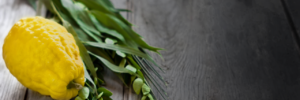
    You might also see some Jews walking in the street during Sukkot carrying an interesting collection of plants. These are the Arba’at Haminim, or the “Four Species”. It is made up of a long, swordlike palm branch flanked by willow and myrtle branches and bound together with dried palm leaves, accompanied by the fragrant etrog, which is a citrus fruit and looks like a bumpy lemon.

    With the Four Species in hand, one recites a blessing and waves or shakes the species in all six directions (east, south, west, north, up and down) each day of the Sukkot holiday, thus symbolizing Divine presence everywhere. On a metaphorical level, each plant represents a different part of the body. The long straight palm branch suggests the spine while the myrtle leaf symbolizes the eye. The willow leaf embodies the mouth, and the etrog manifests the heart. As they shake the lulav and etrog, Jews remember to use all the parts of our body for good.

    Chag sameach – a happy holiday! May your Sukkot holiday be one of joy, togetherness, and peace!

    Filed Under: Judaism

    Selah is
    accredited with

    SELAH
    HOME
    ABOUT US
    TRAVEL & TOURS
    RETREATS
    WORKSHOPS
    CONTACT US
    NEWSLETTER
    REGIONS
    Europe
    Israel, Palestine & Jordan
    Egypt
    Greece & Turkiye
    POPULAR SEARCHES
    Christian Holidays
    Christian Pilgrimage
    Holy Land Tours
    Israel Tours
    Camino Walk Tours
    TRIP STYLE
    Family Friendly
    Fast Paced
    Relaxed Paced
    Unique Cultural Experiences
    Small Group
    With Retreat
    Soft Adventure
    Privacy Policy
    Terms and Conditions
    • ABOUT US
    • BLOG
    • TRIPS & TOURS
    • CONTACT US
    • YOUR FAVOURITES
    • TRAVEL ESSENTIALS
      • INSURANCE
      • TRAVEL MONEY
      • E-SIMS
      • Back
    • SELAH SEED

    Nomination Form

    Nominator Details

    Your Name
    (e.g. lecturer, pastor, mentor, supervisor, friend, colleague)

    Nominee Details

    Nominee’s full name
    (city/state/country)

    Ministry & Training Context

    (e.g. pastoral ministry, teaching, missions, youth, chaplaincy, leadership, theological education)

    Character, Calling & Readiness

    Impact & Multiplication

    (e.g. students, congregation, ministry team, classroom, future church)
    (teaching, preaching, mentoring, writing, curriculum, testimony, etc.)

    Practical Considerations

    Is the nominee aware of this nomination?
    Would the nominee be likely and able to travel in Oct-Nov 2026 if selected?
    (health, accessibility, visa considerations)

    Final Endorsement

    Consent statement:

    Want us to keep you in the loop?

    We're always planning exciting new tours, sharing Selah travel moments, inspiration and most importantly we love hearing about your own experiences.

    Stay in the loop through our newsletter and come and be apart of our Christian community on Facebook.

    SUBSCRIBE
    Selah Australia